This page was generated from
docs/Examples/Modelling_Fluid_Inclusion_Re-equilibration/Example9a_FI_stretching_during_ascent.ipynb.
Interactive online version:
 .
.
Modelling fluid inclusion stretching during simple isothermal ascent
This notebook shows how to model the stretching of CO2 dominated fluid inclusions in olivine using python tool RelaxiFI (DeVitre and Wieser, 2023; EarthArXiv), implemented in DiadFit. Note that this tool is not designed to model FI with fluids other than CO2 at this time, or those in phases other than olivine. It is based on the model of Wanamaker and Evans, 1989.
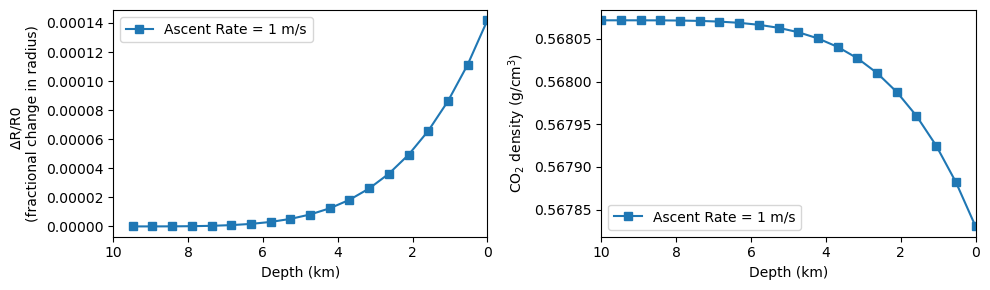
In this example (presented in the DiadFit paper), we model the stretching of a 1 micron radius pure CO2 fluid inclusion, 100 microns away from the crystal rim during ascent from 10km depth to the surface. We consider an ascent rate of 1 m/s (~0.03 MPa/s - equivalent to a Hawaiian style eruption) and a temperature of 1200 degrees celsius.
First, make sure CoolProp is installed if using the Span and Wagner 1996 equation of state
You only need to run this once. If you do not wish to use CoolProp, or face installation problems, please use ‘SP94’ instead of ‘SW96’
If you have Python installed through Anaconda, you may want to install through your conda command line ‘conda install conda-forge::coolprop’. Else you can use ‘pip install CoolProp’ as below.
[1]:
#!pip install CoolProp
#!pip install --upgrade DiadFit
Next import the necessary packages, including DiadFit
[1]:
import pandas as pd
import numpy as np
import matplotlib.pyplot as plt
import DiadFit as pf
pf.__version__
[1]:
'0.0.91'
Now let’s model stretching and evaluate how density, pressure and radius change
First, set the initial conditions
[2]:
# Temperature in Kelvin (Here 1200 degrees Celsius converted to Kelvin)
T_K = 1200 + 273.15

# radius of the FI in meters (here 1 micron)
R_m = 1 * 10**-6

# distance to the crystal edge or crack (here 100 microns)
b_m=100*10**-6

# ascent rate in m/s
ascent_rate_ms=1

#This defines the starting depth, ending depth and the number of steps in the path. More steps is better, especially for slow ascent rates.
depth_path_ini_fin_step=[10,0,20]

# the configuration of your crustal model, here we set a single crustal density for the
#  whole path; you can call help (pf.config_crustalmodel) for more options
crustal_model_config=pf.config_crustalmodel(crust_dens_kgm3=2750)

# Equation of state for CO2 (SW96 or SP94) if using SW96, ensure CoolProp is installed
EOS='SW96'

# Whether to plot the figure or not
plotfig=True

# Whether to update b as the radius of the FI changes
update_b=False

# Whether to report all the results, only the first and last step or only the last step
report_results='fullpath'
Now run the model
Note that the decrease in density for the conditions of our model is very small (< 1%), in fact much smaller than the uncertainty in any measurement that could be made.
[3]:
results = pf.stretch_in_ascent(R_m=R_m, b_m=b_m,T_K=T_K,ascent_rate_ms=ascent_rate_ms,
                               crustal_model_config=crustal_model_config,
                                 depth_path_ini_fin_step=depth_path_ini_fin_step,
                                 EOS=EOS,plotfig=plotfig,update_b=update_b,report_results=report_results)

results.head()
c:\users\penny\box\berkeley_new\diadfit_outer\src\DiadFit\relaxifi.py:434: FutureWarning: Setting an item of incompatible dtype is deprecated and will raise in a future error of pandas. Value '526.315789473685' has dtype incompatible with int64, please explicitly cast to a compatible dtype first.
  results.loc[i] = [dt_s*i, i, dt_s, Pexternal, Pinternal_MPa, dR_dt, R_m * 10 ** 6, b_m * 10 ** 6,

[3]:
| Time(s) | Step | dt(s) | Pexternal(MPa) | Pinternal(MPa) | dR/dt(m/s) | Fi_radius(μm) | b (distance to xtal rim -μm) | ΔR/R0 (fractional change in radius) | CO2_dens_gcm3 | Depth(km) | |
|---|---|---|---|---|---|---|---|---|---|---|---|
| 0 | 0.000000 | 0 | 0.000000 | 269.775000 | 269.775000 | 0.000000e+00 | 1.0 | 100.0 | NaN | 0.568072 | 10.000000 |
| 1 | 526.315789 | 1 | 526.315789 | 255.576316 | 269.774999 | 1.446726e-18 | 1.0 | 100.0 | 7.614349e-10 | 0.568072 | 9.473684 |
| 2 | 1052.631579 | 2 | 526.315789 | 241.377632 | 269.774986 | 1.754262e-17 | 1.0 | 100.0 | 9.994390e-09 | 0.568072 | 8.947368 |
| 3 | 1578.947368 | 3 | 526.315789 | 227.178947 | 269.774931 | 7.551312e-17 | 1.0 | 100.0 | 4.973814e-08 | 0.568072 | 8.421053 |
| 4 | 2105.263158 | 4 | 526.315789 | 212.980263 | 269.774777 | 2.127162e-16 | 1.0 | 100.0 | 1.616940e-07 | 0.568072 | 7.894737 |
We can then replot and save the figure
[4]:
plt.rcParams['pdf.fonttype'] = 42
plt.rcParams['ps.fonttype'] = 42

fig, (ax0,ax1) = plt.subplots(1,2, figsize=(10,3))
ax0.plot(results['Depth(km)'],results['\u0394R/R0 (fractional change in radius)'],marker='s',label=f"Ascent Rate = {ascent_rate_ms} m/s")
ax0.set_xlim([depth_path_ini_fin_step[0],depth_path_ini_fin_step[1]])
ax0.set_xlabel("Depth (km)")
ax0.set_ylabel('\u0394R/R0  \n(fractional change in radius)')

ax1.plot(results['Depth(km)'],results['CO2_dens_gcm3'],marker='s',label=f"Ascent Rate = {ascent_rate_ms} m/s")
ax1.set_xlim([depth_path_ini_fin_step[0],depth_path_ini_fin_step[1]])
ax1.set_xlabel("Depth (km)")
ax1.set_ylabel("CO$_2$ density (g/cm$^{3}$)")
ax0.legend(loc='best')
ax1.legend(loc='best')
fig.tight_layout()
plt.show()
fig.savefig("fig4diadfit_paper_relaxifi.png", dpi=300)
[ ]: