This page was generated from
docs/Examples/Fitting_Water_Silicate_Melts/Example4b_H2OQuant_MI/H2O_Fitting_MI_AutoLoop.ipynb.
Interactive online version:
 .
.
Fitting H2O and Silicate areas from unexposed MIs (looping)
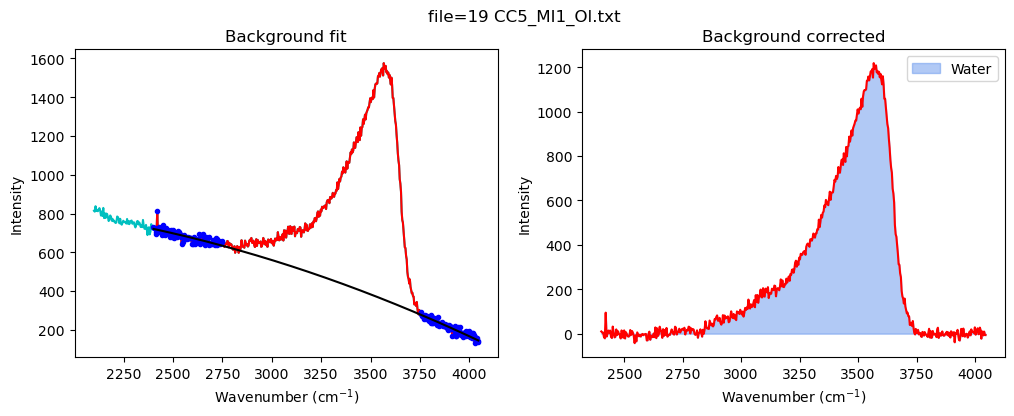
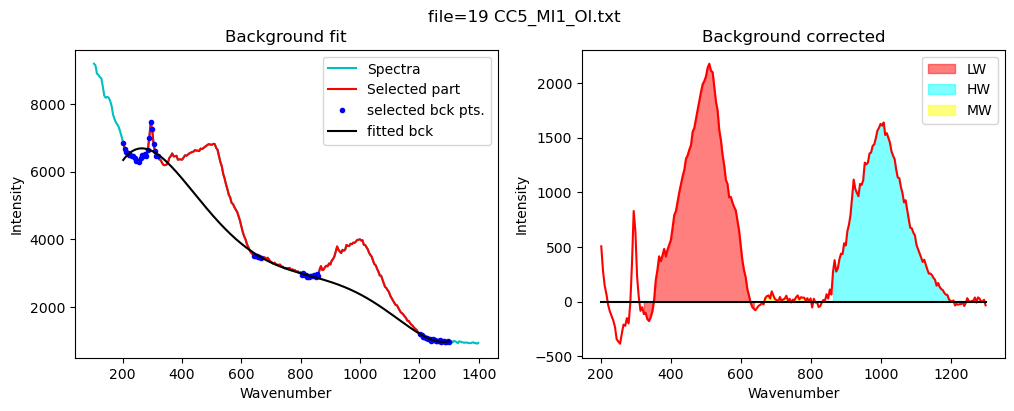
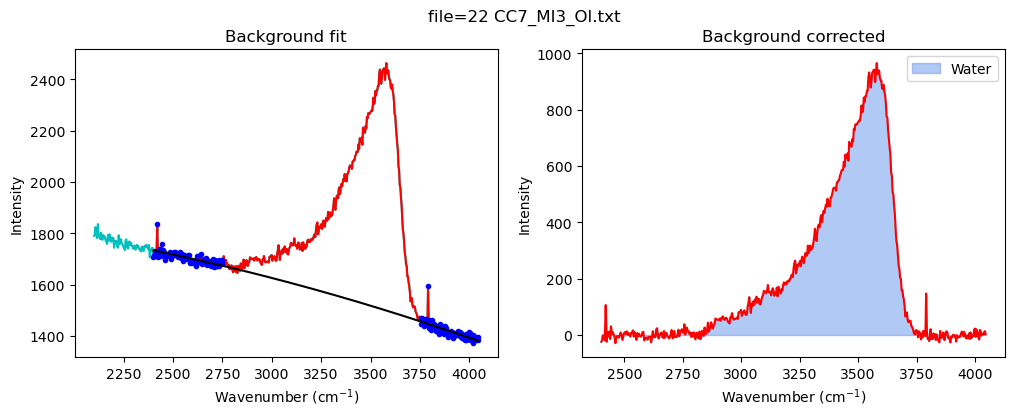
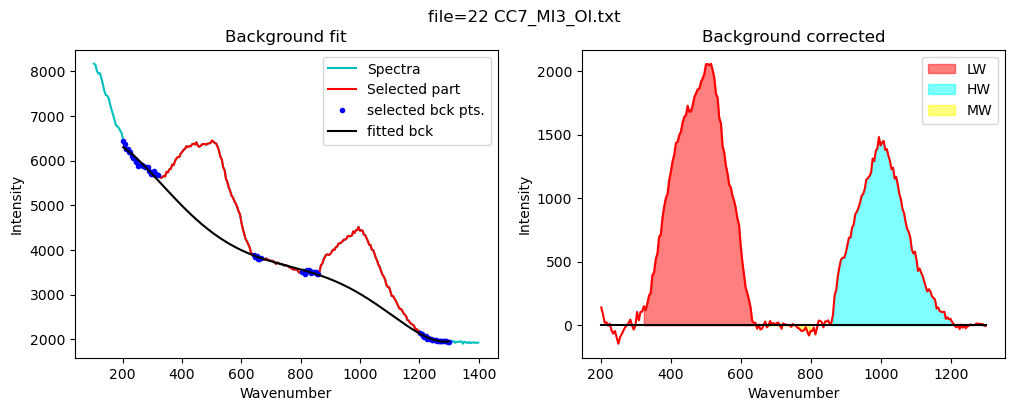
This notebook shows how to quantify the relative area of the silicate peak and H2O peak from acquisitions of olivine-hosted melt inclusions still at depth in the crystal. Specifically, the code unmixes the olivine and melt inclusions spectra to obtain the glass spectra
In this example, we loop through multiple files, as we find we can use the same peak parameters for all of them
If you want an example where you manually loop through files, see the exapmle ‘H2O_Fitting_MI_ManualLoop’
Import necessary python things
[1]:
import numpy as np
import pandas as pd
import matplotlib.pyplot as plt
import DiadFit as pf
pf.__version__
[1]:
'1.0.3'
[2]:
# This is where you tell the code where your spectra are. E.g. DayFolder is the overal folder, if you have subfolders for Spectra and MetaData
import os
DayFolder=os.getcwd()
meta_path=DayFolder +  '\MetaData'
spectra_path=DayFolder + '\Spectra'
file_ext='.txt'
filetype='Witec_ASCII'
[3]:
# Get the files which are the melt inclusion/H2O acquisitoin first. You need a unique string (here H2O) which is in all files
MI_Files=pf.get_files(path=spectra_path,
file_ext=file_ext, ID_str='H2O',
exclude_str=['depth', 'line', 'scan'], sort=False)
MI_Files
[3]:
['02 CC14_MI2_H2O_96mw.txt',
 '05 CC13_MI4_H2O.txt',
 '09 CC9_MI3_H2O.txt',
 '12 CC9_MI1_H2O_20X.txt',
 '15 CC9_MI1_H2O_50X.txt',
 '18 CC5_MI1_H2O_10mw.txt',
 '21 CC7_MI3_H2O.txt',
 '24 CC4_MI1_H2O.txt',
 '29 MS13_2_MI1_H2O.txt']
[4]:
# These are the files for the acquisition in the neighbouring host mineral - in this case, the unique file string is 'Ol'
Host_Files=pf.get_files(path=spectra_path,
file_ext=file_ext, ID_str='Ol',
exclude_str=['depth', 'line', 'scan'], sort=False)
Host_Files
[4]:
['03 CC14_MI2_Ol_96mw.txt',
 '06 CC13_MI4_Ol.txt',
 '10 CC9_MI3_Ol.txt',
 '16 CC9_MI1_Ol_50X.txt',
 '19 CC5_MI1_Ol.txt',
 '22 CC7_MI3_Ol.txt',
 '25 CC4_MI1_Ol.txt',
 '30 MS13_2_MI1_Ol.txt']
Now we want to split up the name into its key parts - this will allow us to match a given melt inclusion file to the host olivine file
[5]:
char_crystal='_' # This is what you separated your string based on, e.g. here we use underscores
print(Host_Files[0].split(char_crystal))
['03 CC14', 'MI2', 'Ol', '96mw.txt']
[6]:
# Here you define what characters separate MI and crystal names. First, we are looking at the files of our host olivine.
pos_crystal=0 # This is which character is the crystal name, e.g. ignoring the prefix, the crystal in the above example is CC14
pos_MI=1 # This is the unique melt inclusion, in the example above this is MI2, which is the second position in the array (so 1 in python which starts counting at zero)
char_MI='_' # If you split your MI using a different string
Host_Files_extract=pf.extract_xstal_MI_name(files=Host_Files, prefix=True, str_prefix=' ',
char_xstal=char_crystal, pos_xstal=pos_crystal, char_MI=char_MI, pos_MI=pos_MI, file_ext=file_ext)
Host_Files_extract.head()
good job, no duplicate file names
[6]:
| filename | crystal_name | MI_name | |
|---|---|---|---|
| 0 | 03 CC14_MI2_Ol_96mw.txt | CC14 | MI2 |
| 1 | 06 CC13_MI4_Ol.txt | CC13 | MI4 |
| 2 | 10 CC9_MI3_Ol.txt | CC9 | MI3 |
| 3 | 16 CC9_MI1_Ol_50X.txt | CC9 | MI1 |
| 4 | 19 CC5_MI1_Ol.txt | CC5 | MI1 |
[7]:
# Now do the same for your melt inclusion files
print(MI_Files[0].split('_'))
['02 CC14', 'MI2', 'H2O', '96mw.txt']
[8]:
MI_Files_extract=pf.extract_xstal_MI_name(files=MI_Files,prefix=True, str_prefix=' ',
char_xstal=char_crystal, pos_xstal=pos_crystal, char_MI=char_MI, pos_MI=pos_MI)
MI_Files_extract.head()
good job, no duplicate file names
[8]:
| filename | crystal_name | MI_name | |
|---|---|---|---|
| 0 | 02 CC14_MI2_H2O_96mw.txt | CC14 | MI2 |
| 1 | 05 CC13_MI4_H2O.txt | CC13 | MI4 |
| 2 | 09 CC9_MI3_H2O.txt | CC9 | MI3 |
| 3 | 12 CC9_MI1_H2O_20X.txt | CC9 | MI1 |
| 4 | 15 CC9_MI1_H2O_50X.txt | CC9 | MI1 |
[9]:
# This aligns the H2O and silicate file based on the same value for the column xstal name and MI name
merge=MI_Files_extract.merge(Host_Files_extract, on=['crystal_name', 'MI_name' ], how='inner')
merge.head()
[9]:
| filename_x | crystal_name | MI_name | filename_y | |
|---|---|---|---|---|
| 0 | 02 CC14_MI2_H2O_96mw.txt | CC14 | MI2 | 03 CC14_MI2_Ol_96mw.txt |
| 1 | 05 CC13_MI4_H2O.txt | CC13 | MI4 | 06 CC13_MI4_Ol.txt |
| 2 | 09 CC9_MI3_H2O.txt | CC9 | MI3 | 10 CC9_MI3_Ol.txt |
| 3 | 12 CC9_MI1_H2O_20X.txt | CC9 | MI1 | 16 CC9_MI1_Ol_50X.txt |
| 4 | 15 CC9_MI1_H2O_50X.txt | CC9 | MI1 | 16 CC9_MI1_Ol_50X.txt |
Select file
select a file to tweak fit parameters
[10]:
# Just choose 1 file to have a look
i=0
filename_MI=merge['filename_x'].iloc[i]
filename_Host=merge['filename_y'].iloc[i]
print(merge['filename_y'].iloc[i])
03 CC14_MI2_Ol_96mw.txt
[11]:
# This pulls out the host file and the MI file
spectra_Host=pf.get_data(path=spectra_path, filename=filename_Host,
            Diad_files=None, filetype=filetype)

spectra_MI=pf.get_data(path=spectra_path, filename=filename_MI,
            Diad_files=None, filetype=filetype)
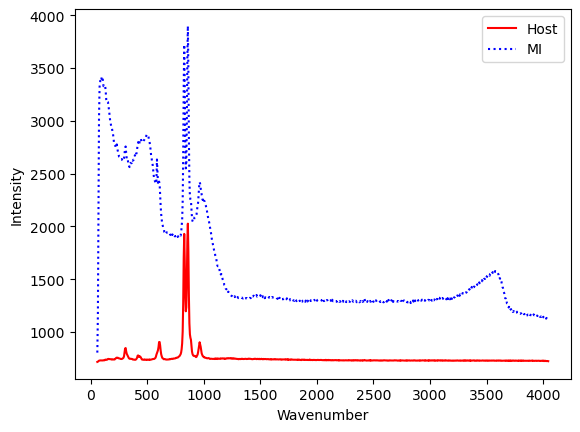
First plot spectra
[12]:
plt.plot(spectra_Host[:, 0], spectra_Host[:,1], '-r', label='Host')
plt.plot(spectra_MI[:, 0], spectra_MI[:,1], ':b', label='MI')
plt.legend()
plt.xlabel('Wavenumber')
plt.ylabel('Intensity')
[12]:
Text(0, 0.5, 'Intensity')
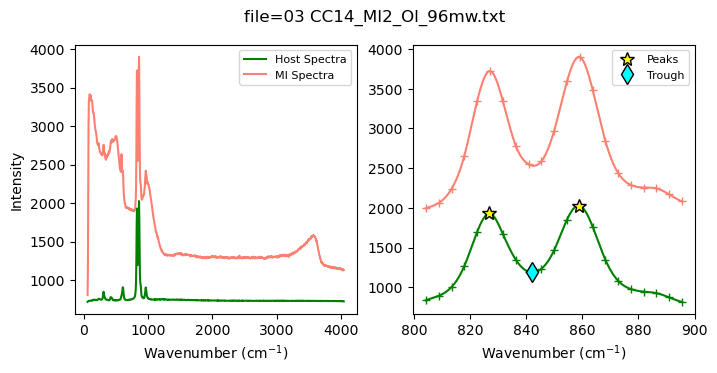
Now, lets smooth and trim the spectra, and find the peaks
[13]:
x_new, y_cub_MI, y_cub_Host, peak_pos_Host, peak_height_Host, trough_x, trough_y, fig=pf.smooth_and_trim_around_host(
x_range=[800,900], x_max=900, Host_spectra=spectra_Host,
MI_spectra=spectra_MI, filename=filename_Host)
fig.savefig('smooth_Spline.png', dpi=300, bbox_inches='tight')
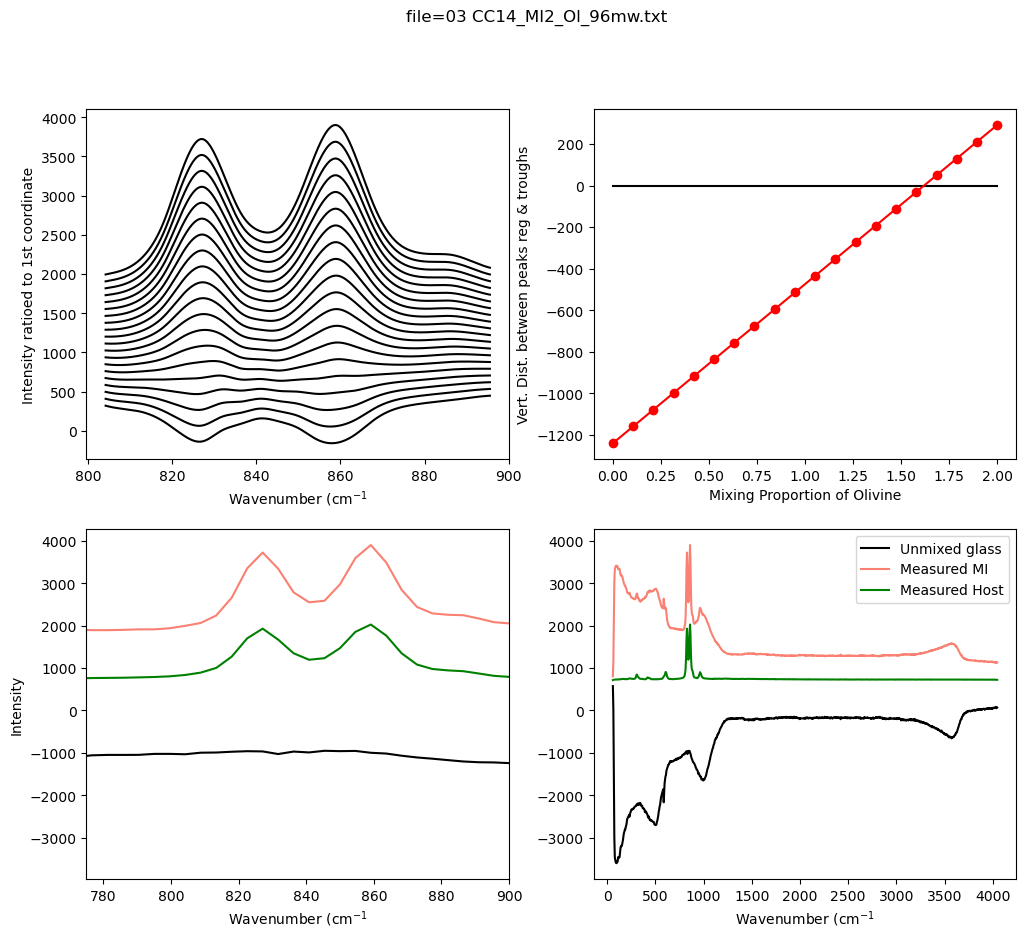
Now lets look at different mixing proportions
[14]:
MI_Mix_Best, ideal_mix, Dist, MI_Mix, X=pf.make_evaluate_mixed_spectra(
path=spectra_path, filename=filename_Host,
smoothed_host_y=y_cub_Host, smoothed_MI_y=y_cub_MI,
Host_spectra=spectra_Host, MI_spectra=spectra_MI, x_new=x_new,
peak_pos_Host= peak_pos_Host,
trough_x=trough_x, trough_y=trough_y, N_steps=20, av_width=2,
X_min=0, X_max=2)
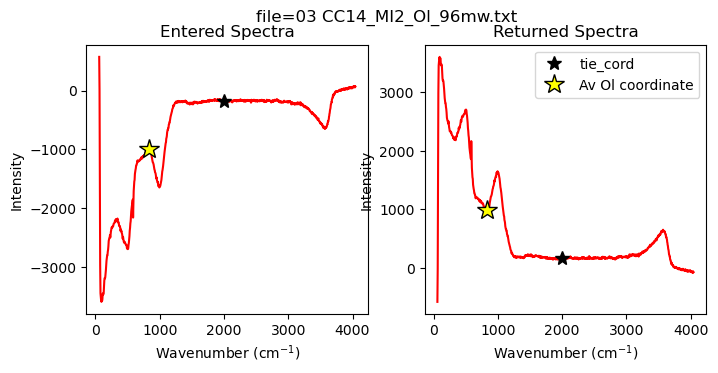
check if spectra needs inverting
Sometimes the best fit spectra will end up upsideown, this inverts it if this happens
[15]:
Spectra2=pf.check_if_spectra_negative(Spectra=MI_Mix_Best,
path=spectra_path, filename=filename_Host,
peak_pos_Host=peak_pos_Host, tie_x_cord=2000, override=False, flip=True)
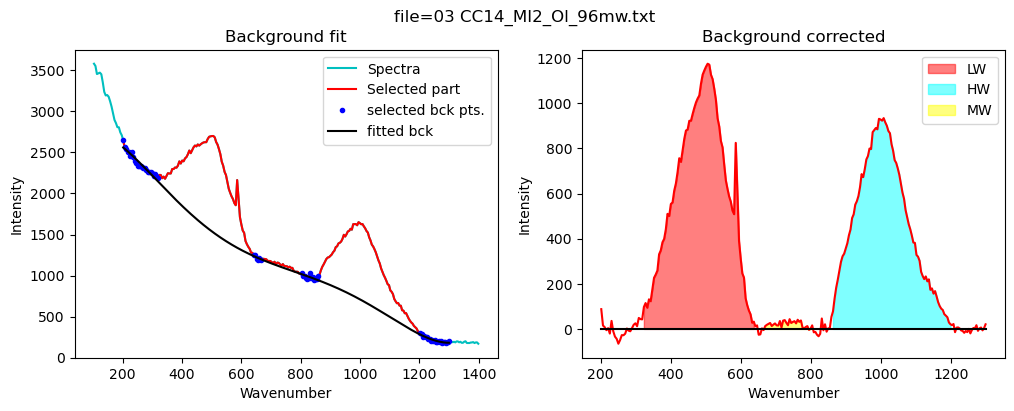
Now lets quantify the area under the silicate region
Set up the background postiions, can overwrite default
[16]:
config_silicate=pf.sil_bck_pos_Schiavi_basalt(
lower_range_sil=(200, 320),
mid_range1_sil=(640, 670), mid_range2_sil=(800, 860),
upper_range_sil=(1200, 1300),
N_poly_sil=5)
[17]:
print(config_silicate)
df_sil=pf.fit_area_for_silicate_region(Spectra=Spectra2,
path=spectra_path, filename=filename_Host, config1=config_silicate,
 plot_figure=True,
fit_sil='poly')
df_sil
sil_bck_pos_Schiavi_basalt(lower_range_sil=(200, 320), mid_range1_sil=(640, 670), mid_range2_sil=(800, 860), upper_range_sil=(1200, 1300), LW=(400, 600), HW=(800, 1200), N_poly_sil=5, sigma_sil=5)
[17]:
| Silicate_LHS_Back1 | Silicate_LHS_Back2 | Silicate_RHS_Back1 | Silicate_RHS_Back2 | Silicate_N_Poly | Silicate_Trapezoid_Area | Silicate_Simpson_Area | LW_Silicate_Trapezoid_Area | LW_Silicate_Simpson_Area | HW_Silicate_Trapezoid_Area | HW_Silicate_Simpson_Area | MW_Silicate_Trapezoid_Area | MW_Silicate_Simpson_Area | |
|---|---|---|---|---|---|---|---|---|---|---|---|---|---|
| 0 | 200 | 320 | 1200 | 1300 | 5 | 379864.496263 | 379745.013178 | 198303.832398 | 198693.030414 | 163488.966895 | 163563.287063 | 2856.492903 | 2889.766264 |
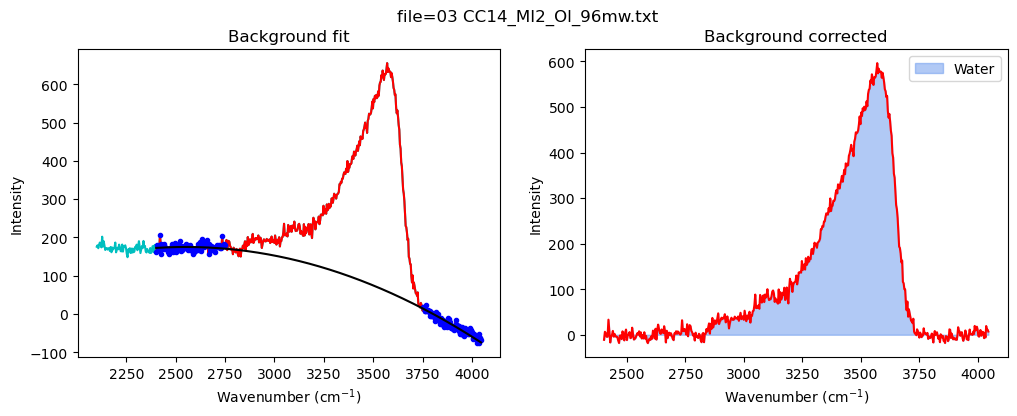
Now quantify the area under the water region
[18]:
config_MI=pf.water_bck_pos(lower_bck_water=(2400, 2750),
N_poly_water=2)
print(config_MI)
df_MI=pf.fit_area_for_water_region(
path=spectra_path, filename=filename_Host,
Spectra=Spectra2, config1=config_MI, plot_figure=True)
water_bck_pos(fit_water='poly', N_poly_water=2, lower_bck_water=(2400, 2750), upper_bck_water=(3750, 4100))
[19]:
combo_out=pf.stitch_dataframes_together(df_sil=df_sil, df_water=df_MI,
Host_file=filename_Host, MI_file=filename_MI)
combo_out
[19]:
| Host filename | MI filename | Water_to_HW_ratio_Trapezoid | Water_to_HW_ratio_Simpson | Water_to_Total_Silicate_ratio_Trapezoid | Water_to_Total_Silicate_ratio_Simpson | Water_Trapezoid_Area | Water_Simpson_Area | Silicate_Trapezoid_Area | Silicate_Simpson_Area | ... | HW_Silicate_Trapezoid_Area | HW_Silicate_Simpson_Area | MW_Silicate_Trapezoid_Area | MW_Silicate_Simpson_Area | Water Filename | Water_LHS_Back1 | Water_LHS_Back2 | Water_RHS_Back1 | Water_RHS_Back2 | Water_N_Poly | |
|---|---|---|---|---|---|---|---|---|---|---|---|---|---|---|---|---|---|---|---|---|---|
| 0 | 03 CC14_MI2_Ol_96mw.txt | 02 CC14_MI2_H2O_96mw.txt | 1.29263 | 1.291034 | 0.556332 | 0.556073 | 211330.717146 | 211165.80878 | 379864.496263 | 379745.013178 | ... | 163488.966895 | 163563.287063 | 2856.492903 | 2889.766264 | 03 CC14_MI2_Ol_96mw.txt | 2400 | 2750 | 3750 | 4100 | 2 |
1 rows × 27 columns
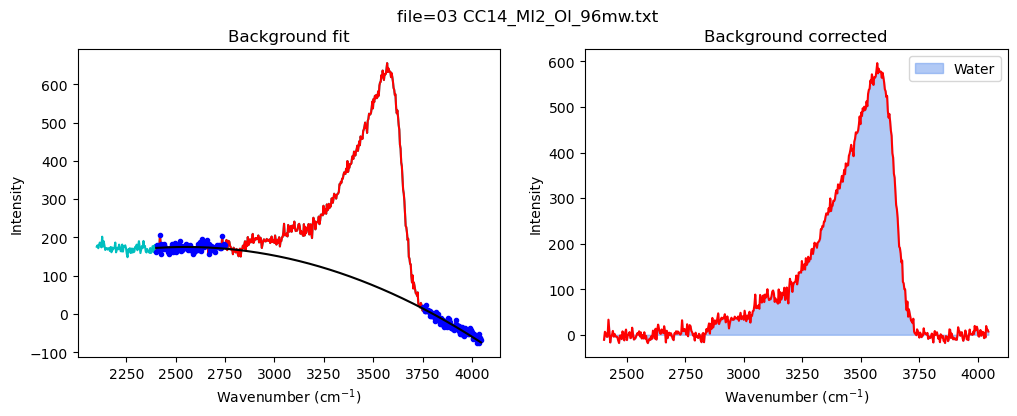
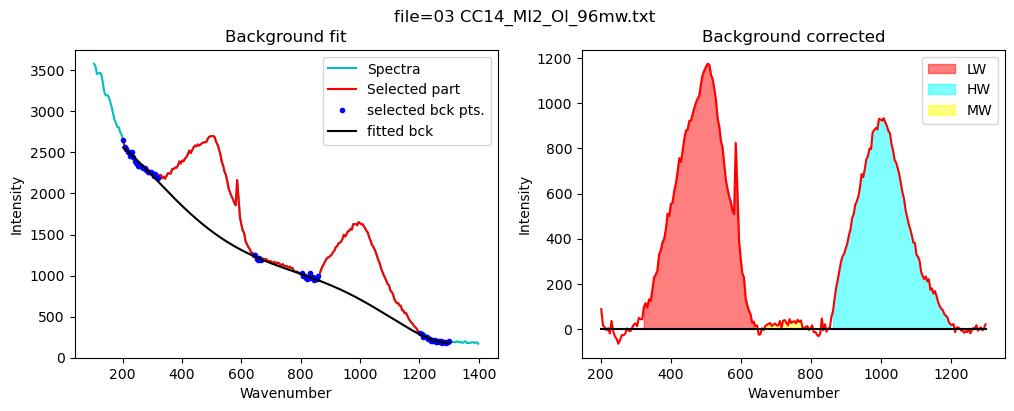
Now we have set it up for one melt inclusion host pair, we can use the same parameters to loop through all files
[20]:
## Now lets loop through all files
from tqdm import tqdm

df_merged=pd.DataFrame([])
for i in tqdm(range(0, len(merge))):
    filename_MI=merge['filename_x'].iloc[i]
    filename_Host=merge['filename_y'].iloc[i]


    # Get files
    spectra_Host=pf.get_data(path=spectra_path, filename=filename_Host,
            Diad_files=None, filetype=filetype)

    spectra_MI=pf.get_data(path=spectra_path, filename=filename_MI,
            Diad_files=None, filetype=filetype)

    # Smooth spectra
    x_new, y_cub_MI, y_cub_Host, peak_pos_Host, peak_height_Host, trough_x, trough_y=pf.smooth_and_trim_around_host(
    x_range=[800,900], x_max=900, Host_spectra=spectra_Host,
    MI_spectra=spectra_MI, filename=filename_Host, plot_figure=False)

    # Get best fit mixing proportions
    MI_Mix_Best, ideal_mix, Dist, MI_Mix, X=pf.make_evaluate_mixed_spectra(
    path=spectra_path, filename=filename_Host,
    smoothed_host_y=y_cub_Host, smoothed_MI_y=y_cub_MI,
    Host_spectra=spectra_Host, MI_spectra=spectra_MI, x_new=x_new,
    peak_pos_Host= peak_pos_Host,
    trough_x=trough_x, trough_y=trough_y, N_steps=20, av_width=2,
    X_min=0, X_max=2, plot_figure=False)


    Spectra2=pf.check_if_spectra_negative(Spectra=MI_Mix_Best,
    path=spectra_path, filename=filename_Host,
    peak_pos_Host=peak_pos_Host, tie_x_cord=2000,
    override=False, flip=True, plot_figure=False)

    # Fit water
    df_H2O=pf.fit_area_for_water_region(
    path=spectra_path, filename=filename_Host,
    Spectra=Spectra2, config1=config_MI, plot_figure=True)

    # Fit silica spectra
    df_sil=pf.fit_area_for_silicate_region(Spectra=Spectra2,
    path=spectra_path, filename=filename_Host, config1=config_silicate,
     plot_figure=True,
    fit_sil='poly')

    data=pf.stitch_dataframes_together(df_sil=df_sil,
        df_water=df_H2O,
Host_file=filename_Host, MI_file=filename_MI)

    df_merged = pd.concat([df_merged, data], axis=0)

df_merged=df_merged.reset_index(drop=True)
100%|██████████| 9/9 [00:06<00:00, 1.40it/s]
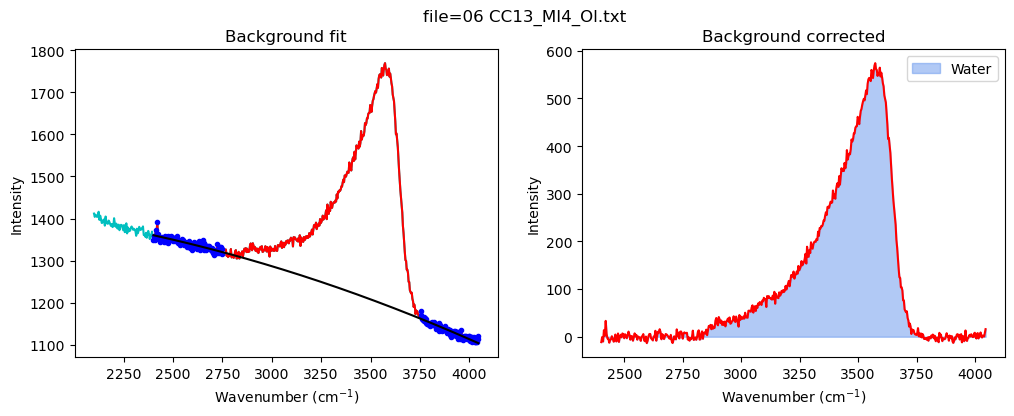
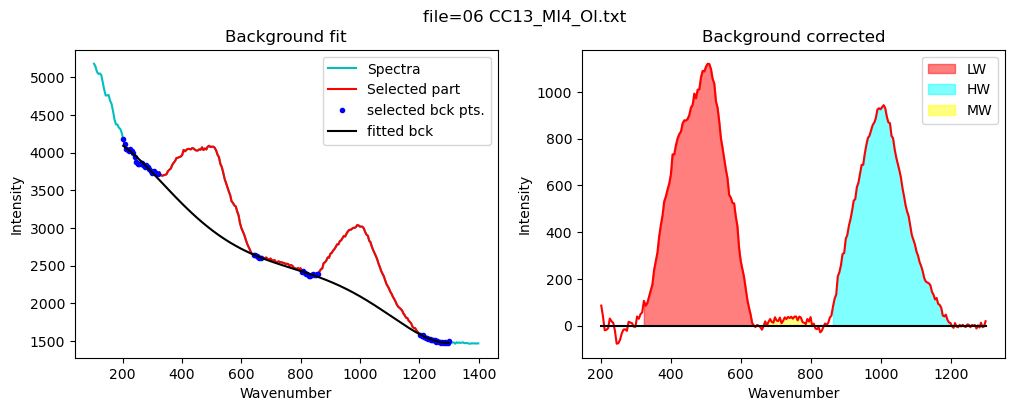
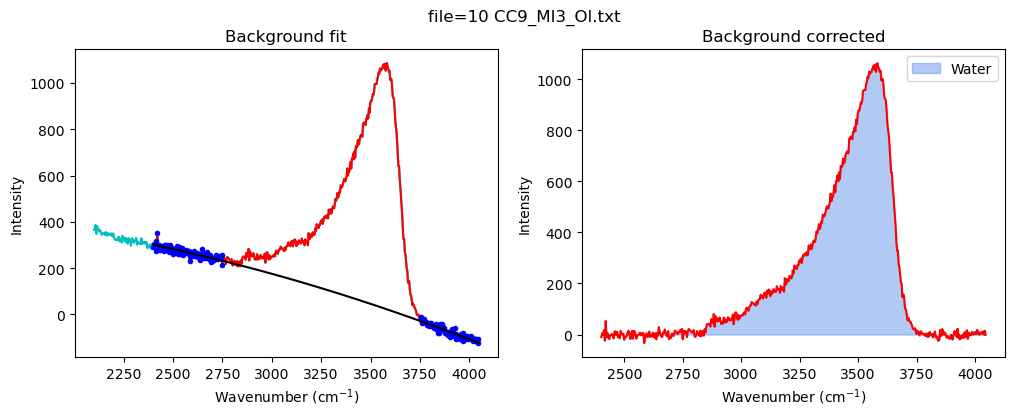
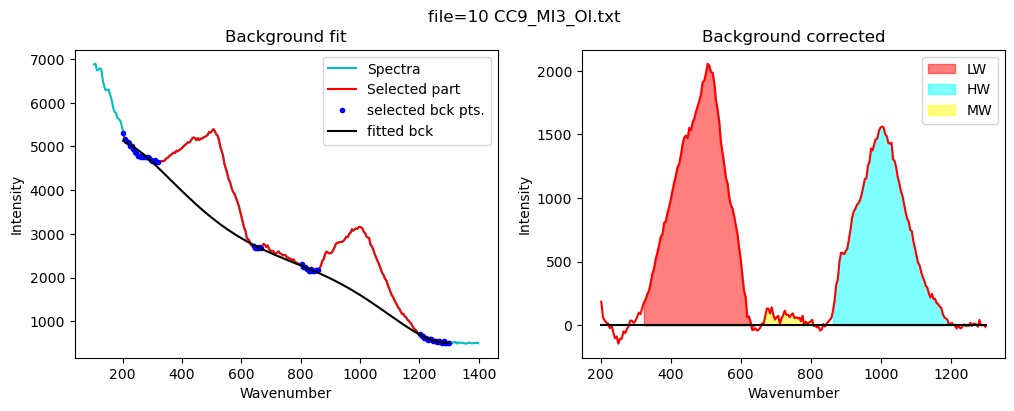
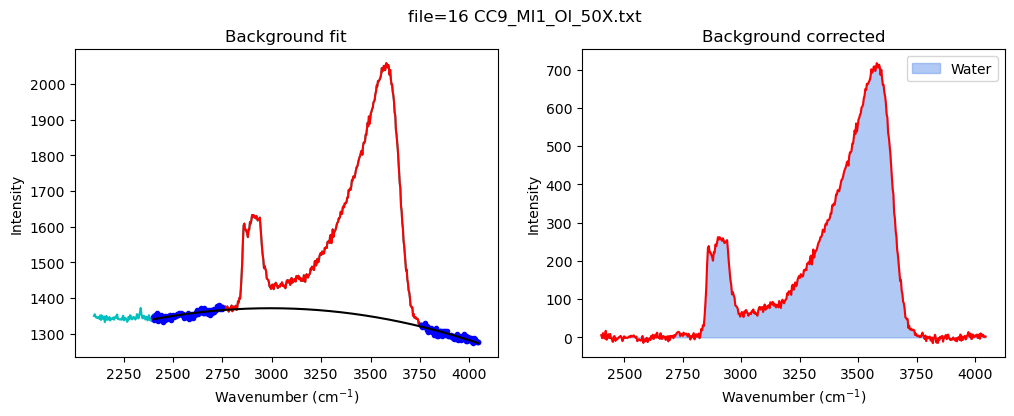
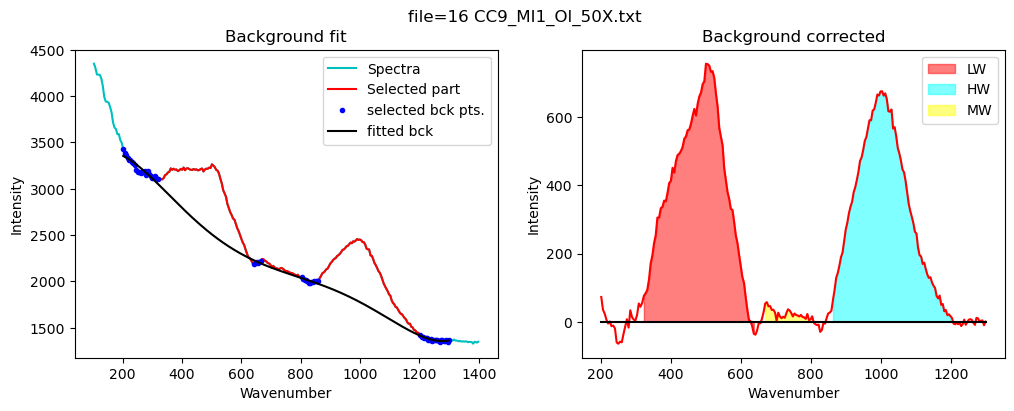
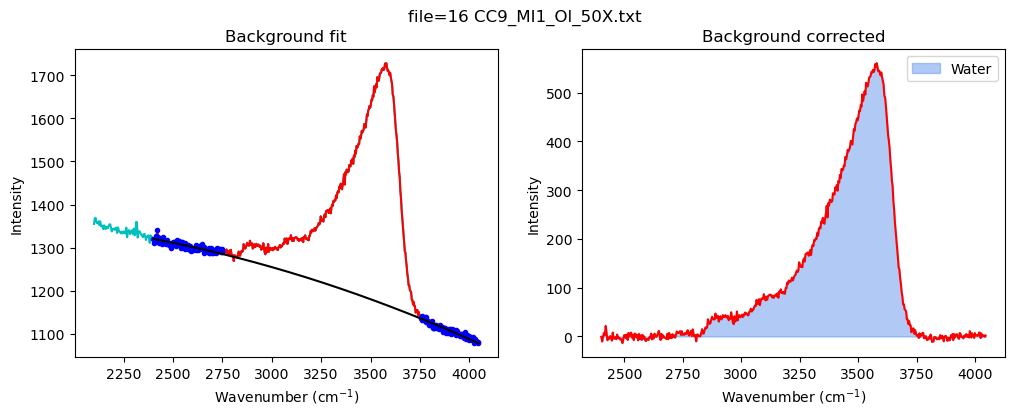
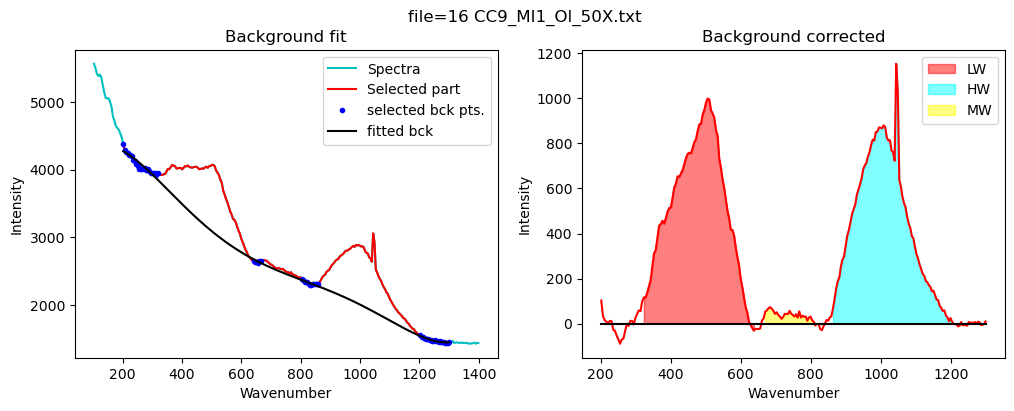
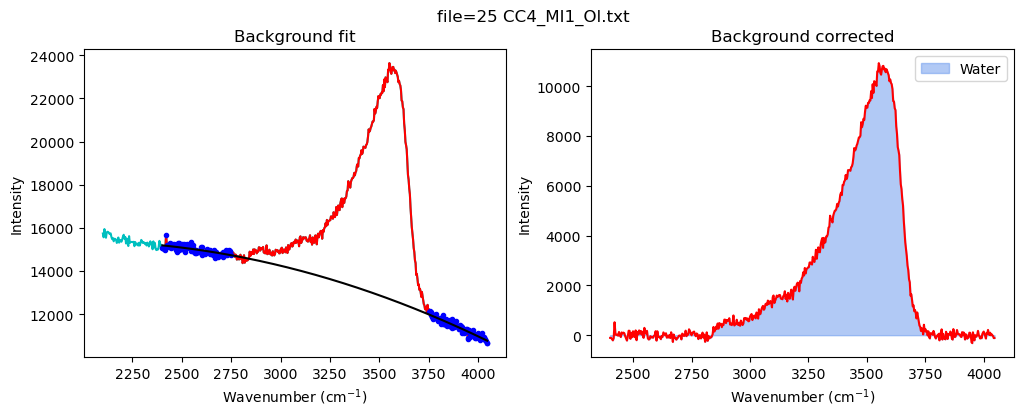
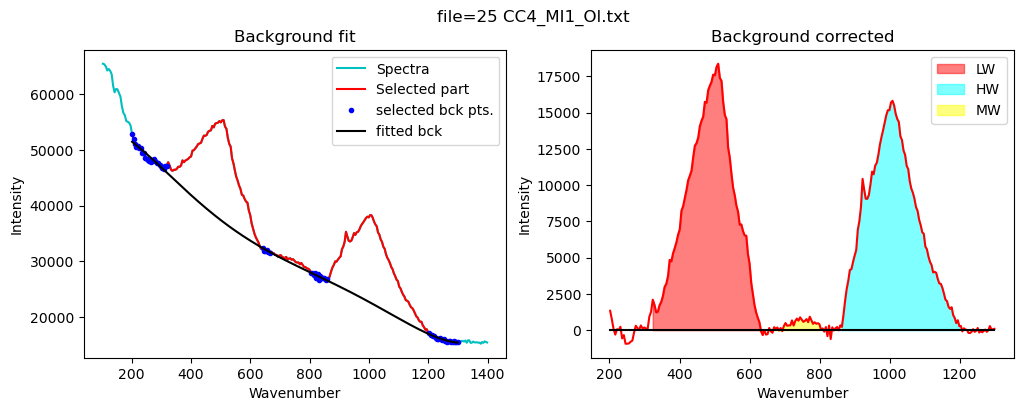
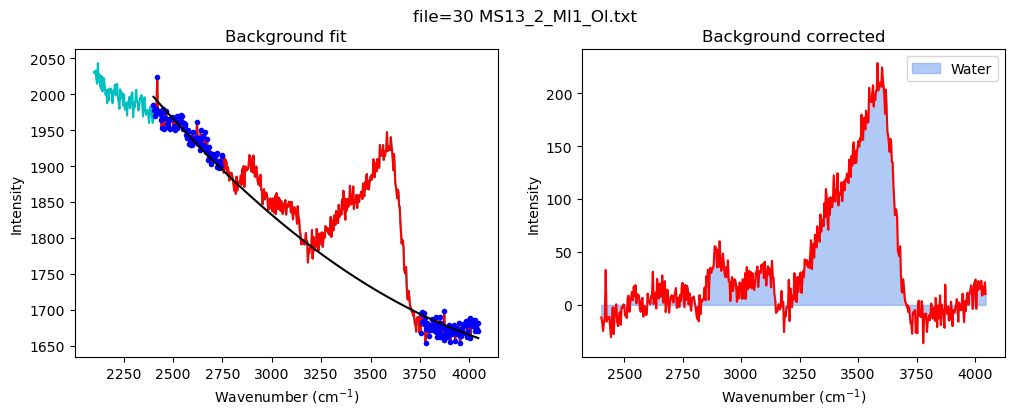
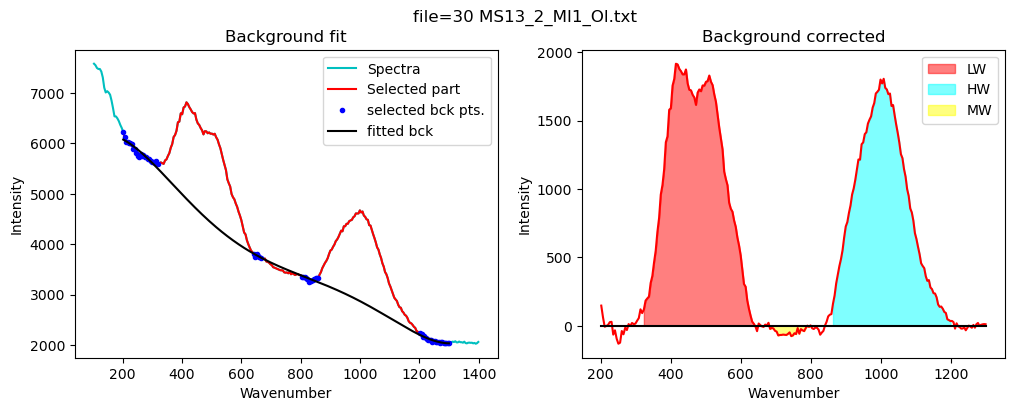
[21]:
# You can inspect the results here
df_merged.head()
[21]:
| Host filename | MI filename | Water_to_HW_ratio_Trapezoid | Water_to_HW_ratio_Simpson | Water_to_Total_Silicate_ratio_Trapezoid | Water_to_Total_Silicate_ratio_Simpson | Water_Trapezoid_Area | Water_Simpson_Area | Silicate_Trapezoid_Area | Silicate_Simpson_Area | ... | HW_Silicate_Trapezoid_Area | HW_Silicate_Simpson_Area | MW_Silicate_Trapezoid_Area | MW_Silicate_Simpson_Area | Water Filename | Water_LHS_Back1 | Water_LHS_Back2 | Water_RHS_Back1 | Water_RHS_Back2 | Water_N_Poly | |
|---|---|---|---|---|---|---|---|---|---|---|---|---|---|---|---|---|---|---|---|---|---|
| 0 | 03 CC14_MI2_Ol_96mw.txt | 02 CC14_MI2_H2O_96mw.txt | 1.292630 | 1.291034 | 0.556332 | 0.556073 | 211330.717146 | 211165.808780 | 379864.496263 | 379745.013178 | ... | 163488.966895 | 163563.287063 | 2856.492903 | 2889.766264 | 03 CC14_MI2_Ol_96mw.txt | 2400 | 2750 | 3750 | 4100 | 2 |
| 1 | 06 CC13_MI4_Ol.txt | 05 CC13_MI4_H2O.txt | 1.273932 | 1.275060 | 0.540900 | 0.540831 | 204905.623402 | 204953.099115 | 378823.385237 | 378959.477396 | ... | 160845.062379 | 160739.920557 | 3243.413314 | 3171.252208 | 06 CC13_MI4_Ol.txt | 2400 | 2750 | 3750 | 4100 | 2 |
| 2 | 10 CC9_MI3_Ol.txt | 09 CC9_MI3_H2O.txt | 1.462606 | 1.464274 | 0.608228 | 0.609066 | 390345.883604 | 390493.015370 | 641775.587932 | 641133.969309 | ... | 266883.839787 | 266680.342116 | 8678.840041 | 8710.813827 | 10 CC9_MI3_Ol.txt | 2400 | 2750 | 3750 | 4100 | 2 |
| 3 | 16 CC9_MI1_Ol_50X.txt | 12 CC9_MI1_H2O_20X.txt | 2.295836 | 2.294857 | 1.036495 | 1.036426 | 271652.008729 | 271618.716229 | 262087.178060 | 262072.519289 | ... | 118323.771655 | 118359.740987 | 3076.166398 | 3017.302181 | 16 CC9_MI1_Ol_50X.txt | 2400 | 2750 | 3750 | 4100 | 2 |
| 4 | 16 CC9_MI1_Ol_50X.txt | 15 CC9_MI1_H2O_50X.txt | 1.290089 | 1.291685 | 0.585702 | 0.586346 | 203547.742283 | 203697.502551 | 347528.113007 | 347401.545257 | ... | 157778.011672 | 157699.085679 | 5423.488225 | 5568.872826 | 16 CC9_MI1_Ol_50X.txt | 2400 | 2750 | 3750 | 4100 | 2 |
5 rows × 27 columns
[22]:
# And save them to Excel here
df_merged.to_excel('H2O_Silicate_areas.xlsx')